Can HSA Pay for Gym Membership? Clear Rules and Smart Ways Explained
Using your HSA to cover a gym membership typically isn’t allowed because most gym fees don’t count as qualified medical expenses under HSA guidelines. You generally can’t spend HSA money on regular gym memberships without facing taxes. Exceptions exist when a healthcare provider issues a Letter of Medical Necessity (LMN) showing that exercise is essential for treating a medical condition, which could make the membership an eligible expense. Start by checking gyms in marketplaces that offer quick LMN consultations, so you can confirm eligibility before using your HSA funds.
Key Takeaways
- Ordinary gym memberships are not HSA-eligible and using HSA funds for them may incur a 20% penalty if under age 65.
- A Letter of Medical Necessity (LMN) is required to use HSA funds for gym memberships tied to specific health conditions.
- The Flex Marketplace offers gyms that provide eligibility screening and LMNs within 24 hours.
- You can use the same LMN for up to 12 months to cover repeated gym membership expenses related to your condition.
- Use gyms or fitness centers specializing in therapeutic exercise rather than general fitness to increase your chances of HSA eligibility.
- Check IRS Publication 502 for detailed rules on qualified and non-qualified medical expenses concerning fitness costs.
Can You Pay for a Gym Membership with HSA Funds?

You cannot use your HSA funds to pay for a standard gym membership by default. The IRS classifies a plain gym membership as a general wellness expense, which does not qualify as a medical expense under IRS Publication 502. This means Using your HSA for a regular gym membership will lead to tax consequences, including income tax on the withdrawn amount plus a 20% penalty if you are under 65.
The main exception to this policy involves obtaining a Letter of Medical Necessity (LMN) from an authorized healthcare professional. This document must clearly state a particular health issue that the gym membership or fitness program will address or assist in managing. Such medical proof is required to qualify the gym membership as an HSA-eligible expense.
To proceed correctly, first consult your doctor to see if your condition qualifies for an LMN. Submit the letter to your HSA administrator before paying to ensure reimbursement eligibility. Without this documentation, most HSA and FSA administrators will deny the expense, meaning you’d have to pay out-of-pocket or risk IRS penalties. The cost of obtaining an LMN varies depending on your provider but usually involves a medical appointment or form completion.
Using your HSA funds for a gym membership without qualifying documentation can lead to denied claims, making you liable for the full cost plus potential tax penalties. The safest approach is to secure the LMN first and keep detailed records and receipts of your payments and health provider’s recommendations. This documentation helps validate your expense if audited by the IRS.
Which Medical Conditions Qualify Gym Memberships for HSA Use?

Gym memberships can qualify for HSA spending only when they are part of a prescribed treatment for specific medical conditions. The IRS usually treats gym fees as general wellness expenses, but a doctor’s diagnosis and recommendation can make them eligible. Conditions like obesity, hypertension, or diabetes often justify using HSA funds because exercise plays a direct role in managing these diseases.
To get reimbursed from your HSA for a gym membership, you must have a Letter of Medical Necessity (LMN) issued by a licensed healthcare professional. This letter should clearly state how the gym membership is part of treating a specific medical condition. HSA providers usually reject claims without this documentation. Just advising increased physical activity isn’t enough; the membership must be linked to an identifiable treatment plan.
- Obesity or morbid obesity diagnosed by a healthcare professional
- Type 2 diabetes requiring exercise for blood sugar control
- Hypertension (high blood pressure) with a prescribed fitness regimen
- Cardiovascular disease needing monitored physical activity
- Arthritis or mobility impairments where exercise improves joint function
- Depression or anxiety managed through therapeutic exercise
- Post-surgery rehabilitation where gym workouts are part of recovery
Once you have a qualifying condition, your medical provider must clearly state that a gym membership is integral to your treatment. You should submit the LMN to your HSA administrator before paying the membership fee and request written confirmation of eligibility. The cost must be reasonable and directly related to managing your condition, which affects how much you can reimburse. Keep in mind some HSA administrators may vary in their approval based on their policies.
How to Obtain and Use a Letter of Medical Necessity (LMN) for Gym Memberships
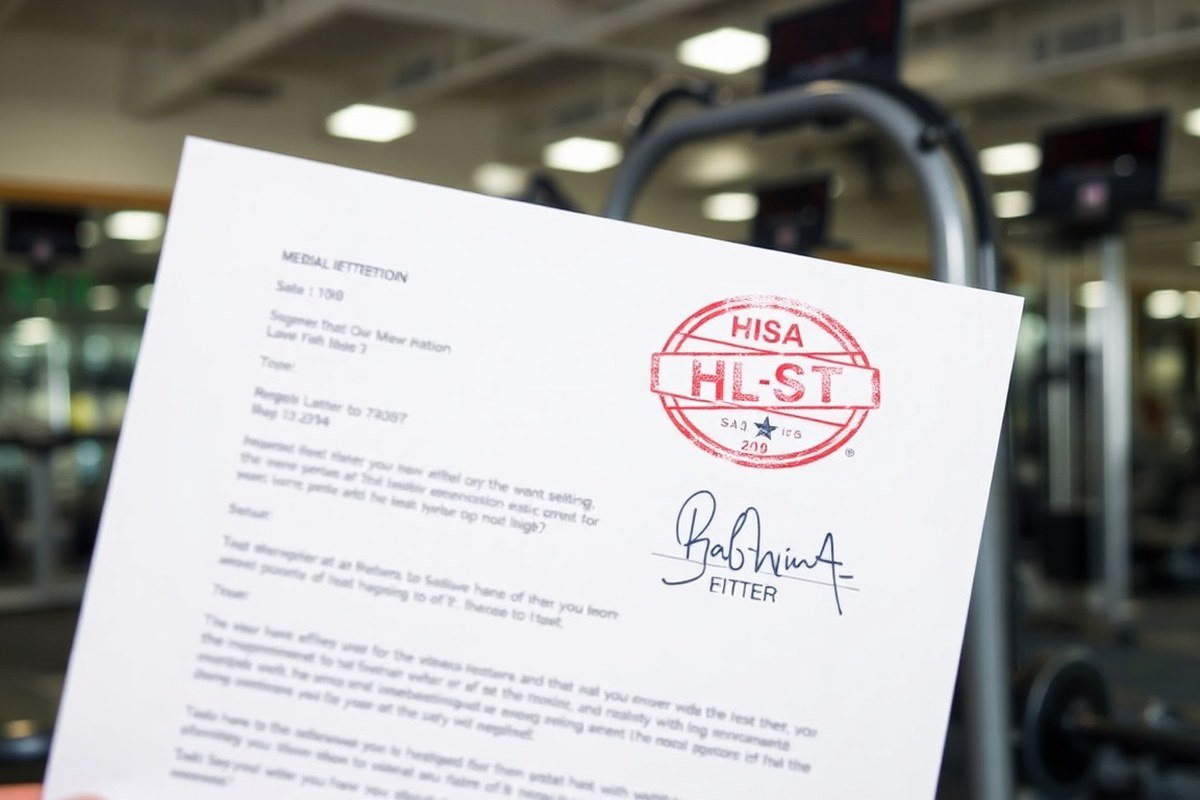
A Letter of Medical Necessity (LMN) is an official note from your doctor stating that a gym membership or fitness program is needed to treat or prevent a certain health issue. This document is key to qualifying your gym fees for HSA spending. The letter must detail your diagnosis, explain why exercise is part of your treatment, and show how the gym membership supports managing your condition. Usually, the LMN is valid for one year, letting you apply it to monthly charges throughout that time.
Obtaining an LMN involves getting a formal diagnosis and a written recommendation from a licensed practitioner. The letter needs to include your healthcare provider’s contact information, your diagnosis, a clear statement that exercise is necessary, and preferably the expected duration of the treatment plan. Without these details, the HSA administrator may reject your claim. To use your HSA funds properly, secure the LMN before paying for your gym membership since expenses incurred before obtaining the letter often do not qualify for reimbursement. Follow these steps to request and use a Letter of Medical Necessity for gym membership expenses:
- Consult a licensed healthcare provider who can diagnose your medical condition and discuss the benefits of exercise as part of your treatment.
- Request a Letter of Medical Necessity that includes your name, diagnosis, recommended exercise, treatment duration (up to 12 months), and the necessity of a gym membership.
- Review the LMN for completeness to ensure it contains all required information to support your HSA claim.
- Submit the LMN to your HSA administrator for prior approval or keep it ready to include with your reimbursement request.
- Make the gym membership payment after receiving the LMN to ensure eligibility for HSA reimbursement.
- Keep all receipts and documentation including the LMN for your records and tax purposes.
- Use the LMN for up to 12 months to file repeated monthly gym membership expenses without needing a new letter each time.
Some platforms, like the Flex Marketplace, offer services to streamline LMN acquisition through online consultations. This may reduce the wait and simplify getting the required documentation. Remember that improper or incomplete LMNs can cause your HSA administrator to deny reimbursement, so attention to detail in the letter is critical.
Top Gyms and Marketplaces That Accept HSA/FSA and Help with LMNs
Some gyms and wellness marketplaces simplify using HSA or FSA funds by accepting payments directly and offering quick Letters of Medical Necessity (LMNs). Truemed and Flex are two platforms frequently used to handle eligibility verification and issue LMNs efficiently. For example, Flex has partnered with gyms like Equinox to enable checkout with your HSA/FSA card online, making payment straightforward without needing to submit reimbursement forms later.
Most traditional gyms may require you to pay out-of-pocket first and then submit a receipt along with your LMN to your HSA/FSA administrator for reimbursement. Obtaining an LMN typically costs around $15 through platforms like Flex, but fees and turnaround times can vary depending on the provider and gym. If you plan to use your HSA/FSA with more than one gym, separate LMNs are necessary for each. Here is a comparison of Truemed and Flex to help you understand how they support HSA/FSA gym memberships and LMNs:
| Feature | Truemed | Flex |
|---|---|---|
| LMN Fee | Shown at checkout; varies by merchant | Approximately $15; example with Equinox |
| Turnaround Time | Varies by provider review | Varies by provider review |
| Partner Network | Broad wellness marketplace | Broad marketplace; official Equinox integration |
| Marketplace Categories | Fitness, recovery, nutrition, and more | Fitness, wellness, equipment, and more |
| Payment Method | Checkout or reimbursement, depending on merchant | Checkout or reimbursement, depending on merchant |
Using these platforms cuts down on guesswork and helps you avoid purchases that might not qualify for HSA or FSA coverage. When you pay directly with your HSA/FSA card through these partners, your reimbursement process is simpler and faster. Otherwise, keep your gym receipts and LMN handy to submit for reimbursement from your HSA/FSA administrator after paying out-of-pocket.
Tax Implications and Risks of Using HSA for Non-Qualified Gym Expenses
Using your HSA funds for a gym membership that the IRS does not classify as a qualified medical expense will result in tax consequences. The amount spent on the non-qualified gym membership must be reported as a non-qualified distribution on Form 8889 when you file your taxes. This amount is then added to your taxable income for the year.
Using HSA funds for a gym membership before age 65 triggers a 20% extra tax on the amount paid. This rule helps prevent spending on fitness costs that the IRS does not approve as qualified medical expenses.
To avoid penalties, confirm with your HSA provider whether your gym membership qualifies under IRS guidelines, often requiring a Letter of Medical Necessity (LMN) from a healthcare provider. Without this documentation, the claim will likely be denied, and you must consider the expense personal.
Here is a simple decision rule to protect yourself: before paying for a gym membership with HSA funds, verify the IRS qualification and obtain any required paperwork. When filing taxes, review Form 1099-SA from your HSA administrator and report any non-qualified distributions on Form 8889. This method ensures compliance and helps avoid unexpected taxes and penalties.
Failing to report non-qualified expenses or using funds without supporting documentation can lead to IRS audits, added tax burdens, and financial risks. Always keep receipts and correspondence related to your HSA expenditures and consult the customer service representatives at your HSA provider for guidance. Following these steps reduces the risk of costly errors and ensures your account remains a valuable tax-advantaged tool for healthcare costs.
Steps to Pay for a Gym Membership Using Your HSA Account
Paying for a gym membership with your HSA requires careful verification and proper paperwork. Start by confirming that your gym membership qualifies under Section 213(d) standards, which require a medical condition and a supporting Letter of Medical Necessity (LMN). Before you spend any HSA funds, check with your HSA administrator to learn their documentation requirements and submission process. Keeping detailed records including the LMN, receipts, and any correspondence ensures smooth reimbursements and compliance with IRS rules.
- Obtain a Letter of Medical Necessity (LMN) from your healthcare provider. This letter must clearly state your diagnosed medical condition and explain why a gym membership is medically recommended.
- Verify eligibility with your HSA administrator before purchasing. Contact the administrator to confirm they accept gym membership claims with your LMN and ask about any forms or specific documentation they require.
- Purchase the gym membership that matches your LMN criteria. Keep the original receipt and any membership agreement that outlines the services provided to link your purchase with medical necessity.
- Gather all documentation, including your LMN, receipts, and any proof of payment. This paperwork proves the expense qualifies if audited by the IRS or your HSA custodian.
- Submit your claim for reimbursement according to your administrator’s instructions. This may include mailing documentation, uploading digital copies, or completing an online form.
- Wait for approval and keep records of the claim approval or denial. If approved, you can use your HSA funds to pay for or reimburse yourself for the membership expense.
- Repeat the process annually or as required if your gym membership and health condition remain unchanged. Update your LMN as needed to ensure ongoing eligibility.
Following these steps reduces the chance your gym membership payment is disallowed and helps you maximize your HSA’s benefits for qualified health expenses.
Differences Between HSA and FSA Gym Membership Eligibility
Gym memberships qualify as medical expenses under the same IRS rules for both Health Savings Accounts (HSAs) and Flexible Spending Accounts (FSAs), specifically under IRS Code 213(d). However, The way each account handles these expenses differs notably. HSAs allow withdrawals for gym memberships if they meet the medical care definition without strict claim deadlines. You can keep receipts indefinitely in case of IRS audits, making your proof of purchase more flexible. FSAs, on the other hand, generally require you to submit claims within the plan year or a short grace period, typically up to 2.5 months after year-end, or risk losing unspent funds.
If you’re using an HSA or FSA to pay for a gym membership, you often need a Letter of Medical Necessity (LMN) from a healthcare provider, especially for conditions like obesity or hypertension. The LMN must outline the medical condition and explain how exercising supports managing or treating it. FSA plans usually require this letter for approval before you get reimbursed, while HSA users only need to keep the LMN and receipts for tax purposes without needing prior approval.
Cost-wise, gym memberships paid through either account follow the same IRS limitation on “medical care,” so without medical necessity, gym dues usually do not qualify. For use under medical necessity, the expenses can sometimes be deducted up to $500 annually on individual tax returns under certain House proposals, but this is not yet permanent IRS policy. Knowing Your plan’s claim requirements and timelines helps you avoid losing access to funds in an FSA, whereas HSAs add flexibility and long-term tax advantages but require you to manage documentation carefully.
Common Mistakes and How to Avoid Them When Using HSA for Gym Memberships
Misunderstanding the rules about Using HSA funds for gym memberships is a common mistake. Many assume all gym memberships qualify for HSA payments, but generally they do not unless you have specific medical documentation. The IRS requires a Letter of Medical Necessity (LMN) to prove the gym membership is prescribed to treat a diagnosed condition. Without this, gym payments risk being classified as non-qualified expenses, which could lead to penalties and taxes.
Another frequent error is failing to keep proper documentation. You must save the LMN, receipts, and any other related paperwork for potential IRS audits, often for up to seven years. Users also mistakenly pay the gym membership directly with a debit card linked to the HSA without confirming if the expense is eligible, leading to denied claims or tax consequences. To avoid these pitfalls, it helps to follow this checklist when using your HSA for gym membership expenses:
- Obtain a clear, dated Letter of Medical Necessity from your licensed healthcare provider.
- Verify that the gym or fitness program explicitly accepts HSA or FSA payments.
- Keep all receipts showing the amount paid, date, and service detail.
- Only use HSA funds for the portion of the membership tied directly to medical treatment.
- Maintain records for at least seven years, especially if your HSA provider requests them.
- Confirm eligibility beforehand by consulting your HSA administrator or tax professional.
Following these tips ensures you stay compliant and avoid unexpected taxes or penalties. Clearly documenting every step, from the physician’s recommendation to your payment, protects you from denied reimbursements. If you do not have an LMN or supporting documentation, it is best not to use your HSA for gym payments, as the IRS may disallow those expenses during a tax review.
Step-by-Step Action Plan to Use Your HSA for a Gym Membership
Follow these steps to properly use HSA funds for a gym membership and avoid tax penalties.
- Before You Enroll: Check if you have a qualifying medical condition that justifies a gym membership under IRS rules. A healthcare provider can confirm this for you.
- Week 1: Obtain a Letter of Medical Necessity (LMN) from your doctor stating the gym membership is prescribed for your condition. This letter should specify how the gym use treats or manages your health issue.
- Week 2: Confirm the gym accepts HSA payments or works with an HSA/FSA compatible marketplace. This ensures you can pay directly from your account without reimbursement hassles.
- Week 3: Submit your LMN to your HSA administrator if required. Keep a copy for your records to support your expense during tax time.
- Week 4: Use your HSA debit card or submit for reimbursement after paying the gym membership dues to ensure funds are allocated properly.
- Ongoing: Monitor your HSA account transactions and save gym and payment receipts. This helps in case of IRS inquiries about your spending.
- End of Year: File your taxes carefully, reporting your HSA withdrawals for gym memberships as qualified medical expenses only with an LMN. Consult a tax professional for guidance.
Frequently Asked Questions
Can I Use HSA Funds to Pay for a Fitness Tracker or Wearable Device?
HSA funds may cover fitness trackers if prescribed by a doctor for a specific medical condition. Otherwise, they’re generally considered non-qualified expenses and not eligible for HSA use.
Are Virtual Gym Memberships Eligible for HSA Payments?
Virtual gym memberships are treated the same as physical gym memberships, so they usually require a medical necessity letter to qualify for HSA payment.
Can I Reimburse Myself from My HSA for a Gym Membership Paid Out of Pocket?
You can reimburse yourself from your HSA for a qualifying gym membership if you have a Letter of Medical Necessity and keep detailed documentation.
Does My Gym Need to Be in the Flex Marketplace to Use HSA Funds?
Your gym does not have to be in the Flex Marketplace to use HSA funds, but select gyms in the marketplace offer easier approval processes for medical necessity.
Can HSA Funds Be Used for Personal Training Sessions?
Personal training sessions are generally not HSA eligible unless prescribed for a specific medical condition documented by your healthcare provider.
Final Thoughts
Using your HSA funds for a gym membership is possible only with proper medical justification and documentation. Getting a Letter of Medical Necessity from your healthcare provider and confirming gym payment acceptance are the best ways to avoid tax risks. Next, contact your doctor about an LMN if you believe a gym membership could improve your health condition, then check your HSA rules before making any payments.