Can I Buy a Treadmill with My Hsa a Complete Guide to Eligibility, Documentation, and Savings
Can I buy a treadmill with my HSA? Yes, you can use your Health Savings Account funds to buy a treadmill if it’s medically necessary. A doctor must provide a signed Letter of Medical Necessity linking the treadmill to your specific health condition. Getting this letter first ensures your purchase qualifies as an eligible medical expense.
Key Takeaways
- A valid Letter of Medical Necessity (LMN) from a board-certified physician is required for HSA treadmill eligibility.
- The LMN must specify a diagnosis and recommend at least 30 minutes of low-impact aerobic exercise most days for 12 months.
- Each LMN is valid for 12 months and must be renewed annually to continue HSA reimbursement.
- You can buy any treadmill brand or model; brand does not affect HSA eligibility when the LMN is in place.
- Use your HSA card to pay directly or reimburse yourself later with a receipt and LMN as documentation.
- Flexible Spending Account (FSA) funds can also be used under similar medical necessity rules, with a yearly contribution limit of $3,200.
Can You Buy a Treadmill with Your HSA Funds?
You can buy a treadmill with your HSA funds, but only if the purchase meets the IRS requirements for medical necessity. The IRS allows spending HSA money on medical equipment that treats or alleviates a diagnosed health condition. Fitness equipment, including treadmills, typically counts as personal fitness expenses, which are not eligible. The key condition is that a healthcare provider must prescribe the treadmill as part of a treatment plan for a specific medical issue, such as rehabilitation after an injury or managing a chronic condition.
The IRS does not approve fitness equipment for general health or exercise purposes alone. To qualify, you need a detailed letter of medical necessity from your doctor. This letter must clearly state the diagnosed condition and explain how the treadmill helps treat or manage it. Without this documentation, your HSA custodian may reject the expense or flag it for potential audit.
After obtaining the letter, contact your HSA custodian to confirm they accept the treadmill purchase as a qualified medical expense. Some custodians request a Letter of Medical Necessity and other supporting documents like a physical therapy plan. The cost of the treadmill itself is not limited by brand or model as long as the medical necessity is established. This means the purchased treadmill can be any suitable equipment recommended by your healthcare provider.
Use this approach to ensure your treadmill purchase qualifies. Buying with proper documentation lowers the risk of IRS audits and helps you use your HSA funds without penalties. Remember that HSA funds never expire, so you can save up for this larger purchase and pay with pre-tax dollars, potentially reducing your overall healthcare costs by an average tax savings rate near 30%, according to tax experts.
Which Medical Conditions Support Treadmill Eligibility?

Health conditions that justify treadmill purchases with your HSA include those where a licensed healthcare provider prescribes treadmill use as a necessary part of your medical treatment. The key criterion is that the treadmill must address a diagnosed condition, not general wellness or fitness. The IRS allows reimbursement for medical expenses that treat, mitigate, or prevent specific diseases, supported by a Letter of Medical Necessity (LMN) from your doctor.
Common qualifying conditions often involve cardiovascular and metabolic diseases, where structured exercise on a treadmill is clinically proven as an effective therapy. For instance, cardiac rehabilitation after heart surgery or heart attack typically involves treadmill walking to improve heart function. Similarly, managing diabetes, especially type 2, can benefit from treadmill exercise to help control blood sugar levels.
- Cardiovascular disease and cardiac rehab: Treadmills support heart recovery by improving endurance and reducing cardiac risk factors.
- Type 2 diabetes or prediabetes: Walking on a treadmill helps regulate blood glucose and supports weight management.
- Obesity with related health issues: A treadmill prescription can be part of a structured weight management plan addressing obesity and hypertension.
- Hypertension: Regular treadmill use can reduce blood pressure under medical supervision.
- Post-surgery or injury rehabilitation: Treadmills assist in restoring mobility and walking ability.
- Arthritis or chronic joint pain: Controlled treadmill exercise can improve joint function and reduce pain.
- Depression or anxiety where exercise is prescribed: Physical activity, including treadmill walking, can be a part of treatment.
You’ll need your doctor to evaluate your medical profile and determine if treadmill use fits your treatment plan. They must provide a signed LMN specifying how the treadmill treats your diagnosed condition. The letter is essential to secure HSA reimbursement and confirm medical necessity. Without it, the purchase might not qualify, even if you have one of these conditions. The cost of obtaining an LMN typically ranges around $29 through specialized services or can be requested from your physician.
How to Get a Valid Letter of Medical Necessity (LMN)
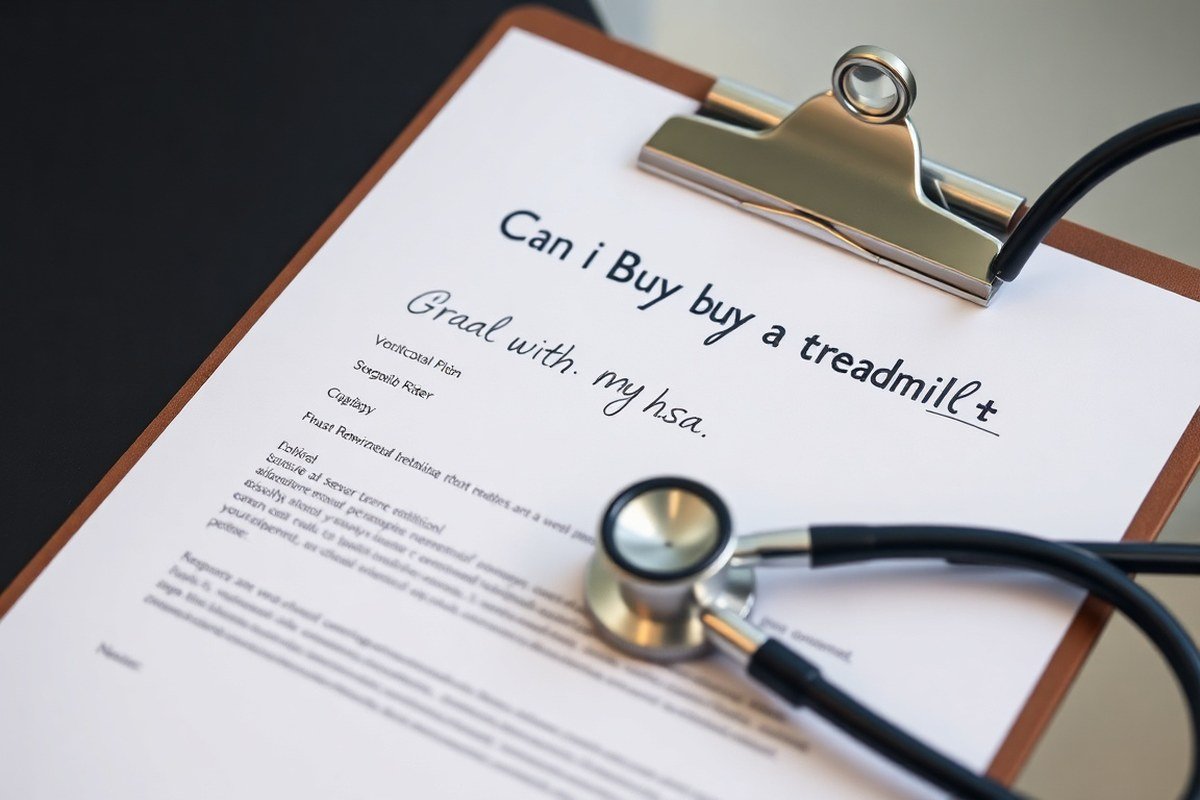
A Letter of Medical Necessity (LMN) is a document from a licensed healthcare provider that explains how a treadmill is medically required to treat a diagnosed condition. This letter links your medical need to the treadmill purchase, making it eligible for payment or reimbursement from your HSA. The LMN must clearly state your specific condition, detail how the treadmill will help manage or improve it, and confirm the prescribed use. A typical LMN also includes your provider’s credentials, the date, and a signature, demonstrating it meets IRS requirements for qualified medical expenses.
To obtain a valid LMN, you can request one from your current doctor or use online services that specialize in quick issuance, usually within 24 hours for a fee around $35. The process often starts with a health review followed by a detailed letter specifically linking the treadmill therapy to your condition. Keep in mind, the LMN is usually valid for one year and needs renewal if you continue using your HSA funds for treadmill-related expenses. Follow these steps to request an LMN:
- Assess your medical condition: Review your diagnosed condition that a treadmill will help treat, ensuring it aligns with medical guidelines for such therapy.
- Contact your healthcare provider: Schedule a brief consultation or use an online telehealth service specializing in LMNs.
- Request the Letter of Medical Necessity: Use a clear script such as, “I need a Letter of Medical Necessity stating my diagnosis of [condition] and how using a treadmill daily will aid my treatment and improve my health.”
- Provide any required medical documentation: Share relevant medical history or test results that support how a treadmill fits your treatment plan.
- Review and receive your LMN: Confirm the letter includes your condition, the prescribed therapy with the treadmill, provider details, date, and signature.
- Use the LMN for reimbursement: Submit the letter alongside your treadmill purchase receipt to your HSA administrator.
- Renew annually if needed: Plan to renew the letter each year to maintain eligibility for ongoing treadmill use via your HSA.
Does Treadmill Brand or Model Affect HSA Eligibility?
The brand or specific model of a treadmill generally does not impact whether it qualifies for purchase with HSA funds. The key factor is whether the treadmill is deemed medically necessary for a diagnosed condition as prescribed by your healthcare provider. Certain features, however, can support the medical use case by aligning with your treatment plan.
For example, features like adjustable incline can be critical when your provider recommends low-impact aerobic exercise targeted to particular health goals, such as improving cardiovascular function or managing arthritis. A model with precise speed control and safety features, like an emergency stop, may also be relevant in your letter of medical necessity (LMN) to demonstrate that the treadmill fits treatment needs. The following table compares common treadmill features and their potential medical benefits to help when discussing options with a clinician and selecting a model for your HSA purchase:
| Treadmill Model | Adjustable Incline | Speed Control Range (mph) | Safety Features | Medical Use Potential |
|---|---|---|---|---|
| Model A | Yes, up to 15% | 0.5 to 10 | Emergency stop, side rails | Supports aerobic therapy, arthritis management |
| Model B | No | 1 to 8 | Emergency stop | Basic walking therapy |
| Model C | Yes, up to 12% | 0.1 to 12 | Emergency stop, low step-up height | Good for balance training, low-impact rehab |
Choose a treadmill featuring settings your healthcare provider can cite as part of your treatment. Mention these features in your LMN to clarify how each supports your medical condition. Consulting your HSA administrator for eligibility details before purchasing avoids surprises.
How to Pay or Get Reimbursed Using Your HSA
You can pay for a treadmill directly with your HSA card or buy it yourself and get reimbursed later. Using your HSA card for the purchase is faster but might require pre-approval or sufficient funds. Your card may be declined; in that case, keep all receipts and submit a reimbursement request to your HSA administrator. The process typically takes a few days to a few weeks, depending on your plan. Clear documentation, including receipts and a Letter of Medical Necessity (LMN), is essential to justify the expense and comply with IRS rules. Here is a step-by-step checklist to pay or get reimbursed using your HSA funds:
- Confirm eligibility. Talk to your healthcare provider and get a valid LMN stating the treadmill is medically necessary.
- Check your HSA balance. Ensure you have enough funds for a direct purchase or plan to split the payment if needed.
- Make the purchase. Use your HSA card if accepted. When declined, pay out of pocket using a credit card or cash, and keep all receipts.
- Gather your documents. Collect the store receipt, LMN, and any other paperwork required by your HSA plan administrator.
- Submit a reimbursement request. Send your documentation through your HSA portal or by following instructions from your administrator. Platforms like Truemed may email specific steps.
- Wait for approval. Reimbursements can take from several days up to a few weeks depending on your administrator’s process.
- Keep records. Store copies of all submitted documents and approvals in case of future audit questions.
Following these steps helps ensure your treadmill purchase is backed by proper medical justification and documentation, increasing the likelihood of reimbursement from your HSA. Always check with your plan administrator about specific submission methods and timelines, as these vary widely.
Can You Use FSA Funds for Treadmill Purchases Too?
You can use FSA funds to buy a treadmill if it qualifies as a medical expense, similar to how you would with an HSA. Both accounts accept eligible medical equipment purchases, but there are key differences between them that affect your buying decision and timing.
FSAs generally have lower annual contribution limits compared to HSAs. For 2024, the IRS sets the FSA contribution limit at $3,200, while HSA limits are $3,850 for individuals and $7,750 for families. This means you might have less money available for a treadmill purchase if using an FSA.
Most importantly, FSA funds are usually tied to your employment status. If you leave your job, you could lose unused FSA money, while HSA funds remain with you even if you change jobs or retire. Also, FSA funds often must be spent within the plan year or a rollover period, typically 90 days after the plan year ends, so timing your treadmill purchase matters.
- Eligibility: Both HSA and FSA allow treadmill purchases if prescribed by a doctor and marked eligible, such as Wahoo’s Truemed-badged models.
- Contribution limits: FSAs capped around $3,200; HSAs cap higher, up to $7,750 for families.
- Account ownership: HSA funds stay with you regardless of employment; FSA funds usually tied to your job.
- Use-it-or-lose-it: FSA funds must typically be spent within the plan year plus a short grace period; HSA funds roll over indefinitely.
- Check eligibility: Always verify treadmill model through your plan or vendors like Wahoo and Truemed for approval.
Using your FSA means carefully planning your purchase within your open enrollment period and confirming the treadmill model’s eligibility with your account administrator. For HSAs, you have flexibility with timing and fund carryover, making it easier to save up or invest before purchasing an expensive treadmill.
Estimating Your Tax Savings When Buying a Treadmill with HSA
Using your HSA funds to buy a treadmill can save you a significant amount on taxes. Your savings come from not paying federal income tax, state income tax (depending on your state), and FICA taxes of 7.65% on the treadmill cost. For example, suppose you purchase a treadmill priced at $1,200 and are in the 30% federal tax bracket. You avoid paying $360 in federal income taxes alone by using your HSA. Adding FICA savings of roughly $91.80 (7.65% of $1,200) increases the total tax savings to about $451.80. State income tax can increase your savings depending on your rate if it applies.
This tax benefit means the treadmill effectively costs you less than the sticker price. Instead of paying $1,200 from after-tax money, you pay with pre-tax HSA dollars, reducing your taxable income by that amount. Paying with regular income taxed at 30% means you’d need to earn about $1,714 before tax to cover a $1,200 treadmill after taxes. Using HSA funds means you only need $1,200.
To calculate your exact benefit, multiply the treadmill price by your combined tax rate, including federal, state, and FICA taxes. For example, a 30% federal, 5% state, and 7.65% FICA tax rate totals approximately 42.65%. On a $1,200 treadmill, that equals roughly $512 saved in taxes. A lower tax bracket of 20% reduces savings to about $256 plus FICA and state tax benefits.
Keep in mind, your tax savings depend on your actual tax bracket and whether you pay state income taxes. Those in higher brackets gain the most using HSA funds for a treadmill. Before purchasing, verify your eligibility and ensure you have sufficient HSA balance to cover the treadmill upfront.
Common Mistakes to Avoid with HSA Treadmill Purchases
Using your HSA funds to buy a treadmill requires careful attention to documentation and eligibility to avoid claim rejections or audits. One common error is not securing a Letter of Medical Necessity (LMN) before purchase. This letter must clearly state your medical condition and why a treadmill is essential for treatment, specifying how it improves your health. Without it, reimbursement claims may be denied.
Another frequent mistake involves paying directly with your HSA card without preparing for substantiation. According to tax guidance, large equipment expenses often trigger requests for additional proof, including both the LMN and purchase receipt. A safer approach is to pay out of pocket and submit a formal claim with all supporting documents attached.
- Skip buying without an LMN: Obtain a doctor’s note tailored to your condition before shopping.
- Failing to keep receipts: Save all invoices and proof of payment, as these are required for claims.
- Not following up on substantiation requests: Respond promptly with detailed documents when your HSA administrator asks.
- Confusing treadmill features: Ensure the model matches your medical needs instead of just general fitness use.
- Ignoring plan-specific rules: Review your HSA custodian’s policies since requirements can vary by provider.
Maintaining thorough records and clearly linking the treadmill purchase to a legitimate health condition helps keep your reimbursement on track. Keep copies of the LMN, receipts, and claim forms organized for several years, as IRS audits can occur long after your initial claim. Taking these steps reduces risk and ensures your investment in health stays compliant with HSA regulations.
Step-by-Step Action Plan for Buying a Treadmill with Your HSA
Follow these steps to confidently use your HSA funds to purchase a treadmill for medical purposes and ensure the process goes smoothly.
- Before you buy: Consult your healthcare provider to confirm that a treadmill is medically necessary for your condition. You’ll know this worked when you receive a written diagnosis or prescription.
- Within the first week: Request a Letter of Medical Necessity (LMN) from your doctor specifying why the treadmill is needed. Verify the letter clearly states your condition and how the treadmill helps.
- Before you shop: Check your HSA plan details to confirm that exercise equipment can qualify with proper documentation. Your HSA provider’s customer service or website can confirm this.
- During purchase: Shop for a treadmill that meets your needs but know brand or model does not affect HSA eligibility. Keep the receipt and any warranty info for your records.
- After purchase: Submit your treadmill receipt and LMN to your HSA administrator for reimbursement if you paid out of pocket. Confirmation will come when the funds are credited back to your account.
- Within one month: Store all documentation securely in case of IRS audit. Successful organisation means you can easily reference all paperwork if needed.
- Ongoing: Track your HSA spending to stay within your annual contribution limits, avoiding any unexpected taxes or penalties.
Frequently Asked Questions
What Treadmills Are HSA Eligible For?
Treadmills like the Commercial 2450, X24 Incline Trainer, and T Series 10 may be HSA eligible if prescribed by a healthcare provider for a medical condition. These models have features that can support a valid Letter of Medical Necessity.
How to Get HSA to Pay for a Treadmill?
You need a healthcare provider to prescribe the treadmill for a diagnosed medical condition and provide a Letter of Medical Necessity. Submit this with your HSA claim to show it’s a qualified medical expense.
What Surprising Things Are HSA Eligible For?
Some unexpected items like certain fitness equipment, medical creams, and even smoking cessation aids can be HSA eligible if used to treat a specific health condition. Always check IRS rules and get provider documentation.
What Fitness Equipment Can I Buy with HSA?
Fitness equipment is HSA eligible only when prescribed to treat a medical condition, not for general fitness. Besides treadmills, items like stationary bikes or special exercise devices may qualify with proper documentation.
Can I Use HSA Funds to Buy Treadmill Accessories Like Mats or Heart Rate Monitors?
Accessories are generally not HSA eligible unless explicitly prescribed by a healthcare provider as part of your treatment. Check your plan rules and get documentation to avoid denied claims.
The Bottom Line
You can use your HSA funds to buy a treadmill if a medical professional certifies it is necessary for your treatment. Start by obtaining a Letter of Medical Necessity from your doctor to support your purchase. Once you have that, make your purchase with documentation in hand and submit everything properly for reimbursement. Taking these clear steps ensures your treadmill purchase can qualify under your HSA and help with managing your health through exercise.